FiSahara and Sahrawi Refugees Show How Storytelling Can Fight Cultural Erasure in Western Sahara
From poetry to solar-powered cinema, community-led projects are preserving identity while pushing for recognition and change.
Exiled But Not Erased in Western Sahara
Navigating memory in exile is like carrying a library in your head. Sahrawi families know this feeling well. Nearly 50 years of exile have separated many from the Western Sahara, the desert homeland of the Sahrawis, a people with Arab, Berber Amazigh, and Black African roots, as described by Nomads HRC. Older people remember the war with Morocco. Many younger Sahrawis were born in refugee camps near Tindouf and know the homeland through stories.
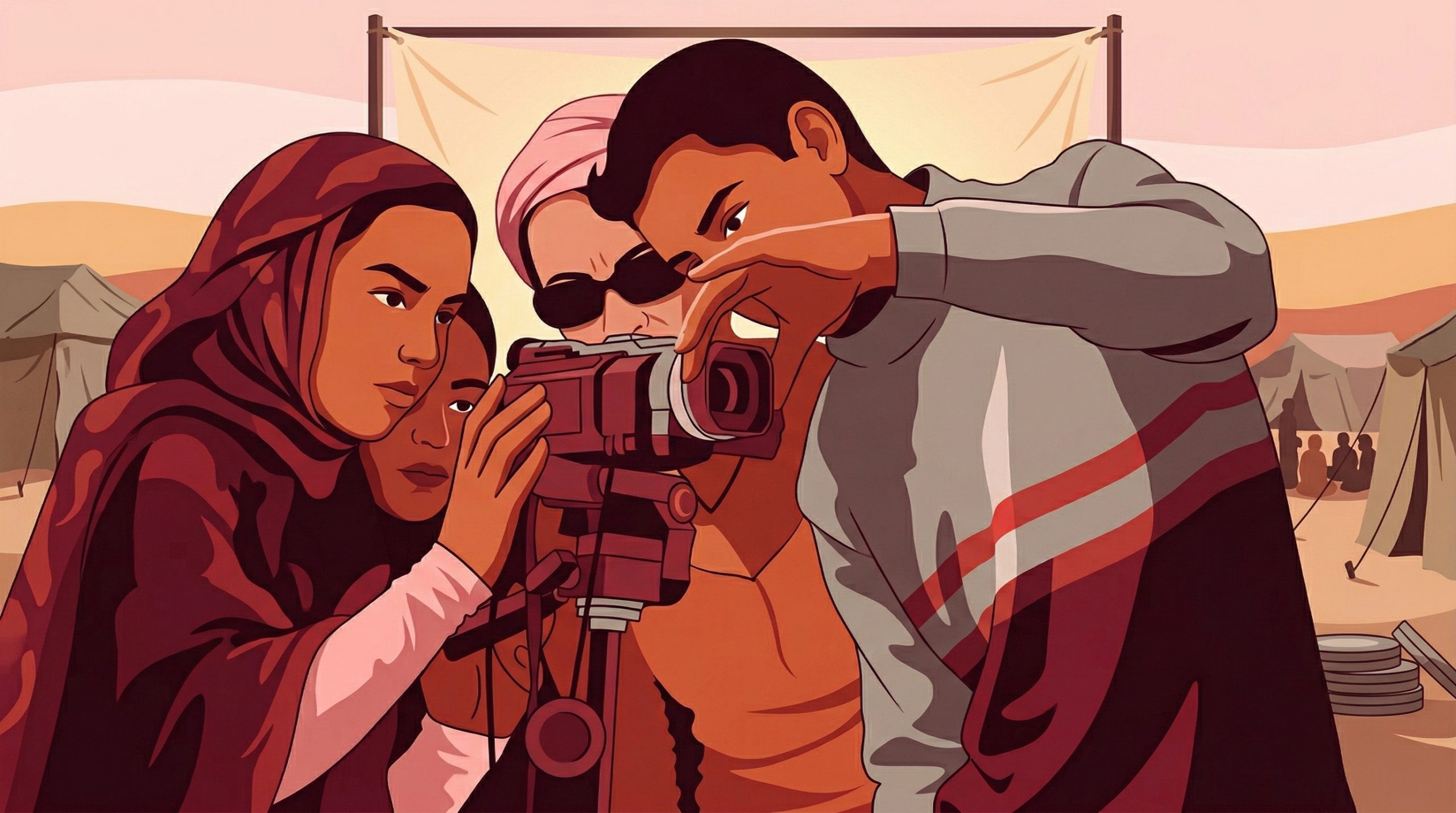
Recording those stories has become a deliberate act. Renowned Sahrawi musician Mariem Hassan faced that reality after learning she had a terminal illness. Hassan invited award-winning Sahrawi filmmaker Javier Corcuera into her childhood home in the Western Sahara desert. Cameras recorded her final reflections on exile for a documentary.
Projects linked to FiSahara, a film festival and initiative co-founded by Corcuera, now teach media skills to young Sahrawis. One example is filmmaker Brahim Chagaf, part of a generation learning to document family memories. Life without a permanent home creates pressure on language, music, and identity. Support from Sahrawi cultural authorities and international organisations, including aid agencies such as the World Food Programme, helps young people.
Life in those camps also carries the weight of a longer political story. Spain withdrew from Western Sahara in 1975 and handed control to Morocco. War followed between Morocco and the Polisario Front, the Sahrawi liberation movement seeking self-determination. Morocco annexed most of the territory in 1976. Thousands were forced to flee into Algeria, echoing the experience of families like those in the sand‑filled bottle houses documented by reporters.
Nearly 200,000 Sahrawis still live there today in five refugee camps near Tindouf. Close to five decades have passed. The United Nations Refugee Agency, UNHCR, describes the situation as the world’s second-longest unresolved refugee crisis. Temporary tents slowly turned into organised settlements. Schools opened. Clinics followed. Internet connections appeared after investment from the Polisario movement, which continues to push for an independent state in Western Sahara, documented in detail by Crisis Group. Daily life still depends heavily on humanitarian aid, while sandstorms and extreme heat shape ordinary routines.
Memory holds many traditions that once moved with nomadic life. The Hassaniya Arabic dialect spoken by Sahrawis survives through conversation, poetry, and songs. Pastoral customs, family histories, and political memories often live in people’s recollections, what one writer called “knowledge stored in the memories of people”. Recording those voices carries another layer of meaning. Oral poetry and music frequently describe the conflict with Morocco. Filming or archiving those words also records how people describe themselves as citizens of the Sahrawi Arab Democratic Republic, SADR, sustaining a national consciousness.
SADR is a founding member of the African Union. Recognition once reached about 80 countries. Support later shifted. The number stood at 47 countries in 2025. Morocco still controls much of Western Sahara, an area known for fisheries and phosphate mines. International recognition of Moroccan claims remains limited, and the International Court of Justice dismissed those claims. A 2,700 km barrier fortified with landmines cuts across the territory. Another political signal appeared in 2020 when a United States president recognised Moroccan sovereignty. Recording a poem, song, or memory often carries quiet political meaning.
How Oral History Found Its Way Onscreen
Cultural work inside the camps gradually moved from informal memory to organised programs. The Sahrawi Ministry of Culture, created by the Polisario during the state-building effort, treats cultural practice as part of national identity. Long exile and repeated claims over Sahrawi heritage by Morocco, which some scholars describe as cultural appropriation, pushed the ministry to act. Reference to international frameworks helped shape the approach. One example is the 2003 UNESCO Convention for the Safeguarding of the Intangible Cultural Heritage, discussed in specialist studies.
Another step came in 2008 with the creation of the International Observatory for the Protection of the Cultural Heritage. The observatory works inside Western Sahara and focuses on archaeological sites, architecture, natural heritage, and oral traditions. Poetry archives and film projects fall under the same effort, including initiatives documented in the Transposition journal.
Oral culture already had a strong place in Sahrawi life. Music and poetry carried political messages during the war years. Polisario leaders encouraged musicians to compose songs known as el nidal. These songs praised martyrs and battles. Lyrics circulated widely and helped keep revolutionary ideas alive during the conflict, as noted in case studies of Sahrawi music.
Poetry moved through memory and voice. Sahrawi poet Al Khadra never learned to read or write. Others wrote down the poems after hearing them. Interviews in which she calls herself illiterate and later testimonies about her work being written down show how spoken lines slowly turned into written records.
Younger Sahrawis now continue similar work through media projects. The Abidin Kaid Saleh Audiovisual School grew out of FiSahara workshops and became the first film school connected to Western Sahara. Students from the school support projects such as Solar Cinema Western Sahara. Solar-powered screens travel between schools and neighbourhoods for public film nights. FiSahara, meaning “in the Sahara” in Arabic, began in 2003 and still brings filmmakers, activists, and local audiences together.
Support also comes from international groups. Nomads HRC and other supporters helped finance training programs and launched Mini FiSahara in 2020 for children in refugee camps. Evening screenings often turn into lessons about Sahrawi history and identity, linking local experience to broader work in the regions where Nomads HRC operates.
Partnerships with the Autonomous University of Madrid, the British Library, and Spanish cultural institutions help preserve Sahrawi music and poetry, as described in research collaborations. A common proverb circulates in Sahrawi communities: “Words uttered at night are erased by day.” The proverb appears in Nomads HRC’s cultural profiles. Recording those words changes that rhythm.
Recording stories also intersects with work, training, and income. UNESCO often links cultural activity with economic opportunity, especially in places with large youth populations. Africa offers one example in reports on culture and sustainable development. About 60% of the continent’s population is under 25. Numbers inside Sahrawi camps look even younger, with more than half under 18.
Cultural and Creative Industries, often shortened to CCI, form a large sector across Africa. Global rankings place the region fifth in size. CCI accounts for 8.2% of total employment, a share higher than any other continent. Young workers dominate the field. Around 20% of total employment in CCI comes from youth. Estimates counted more than 5 million workers in 2023. Revenue numbers also draw attention. Cultural industries across Africa and the Middle East generated about $58 billion in 2015. This is an opportunity for economic empowerment when combined with education, especially in camps where literacy rates are close to 100%.
Education inside Sahrawi camps adds another layer. From the earliest years in exile, the Sahrawi Republic treated education and culture as survival tools. Schools appeared early in exile, often as some of the first structures built in the camps.
Audiovisual training grew from that education system. Film and media skills connect oral storytelling with paid work. The wider North Africa audiovisual and film industry generated about $10 million in 2021. Support from Nomads HRC and partner groups helped establish the Abidin Kaid Saleh Audiovisual School in 2011. The first graduating class finished their studies in 2012. Training programs include more than 1,000 hours of instruction covering directing, editing, and sound.
Graduates now work with Sahrawi radio stations, television services, and independent film crews. Several former Sahrawi instructors teach at the school full-time. Others study abroad through scholarship programmes. Film production has followed the training. Divided Homeland, released in 2013, became the first Sahrawi feature film produced entirely by refugees, and was celebrated in school histories. Leyuadwon received the White Camel Prize at FiSahara in 2016. Student films circulate through festivals in Europe and Africa. Recognition arrived in 2022 when the school received the San Sebastián Human Rights Film Festival Award. Javier Corcuera also continues directing films that win awards at festivals from Málaga to Havana, as noted in festival coverage.
The World Is Watching But Is It Listening
Festival screenings gradually turned into another channel for storytelling beyond the camps. Film, music, poetry, and digital archives allow Sahrawis to present their own accounts while speaking to audiences far from the desert. Cultural expression often doubles as advocacy for Sahrawi rights.
The International Film Festival in Western Sahara, known as FiSahara, illustrates this approach. Sahrawi cultural activists and Spanish civil society groups launched the festival in 2003. Early organisers simply wanted a cinema inside the refugee camps. Over time, the gathering attracted filmmakers, activists, and visitors who treat the festival as a forum for cultural exchange, solidarity, and human rights discussion, a role emphasised in FiSahara’s own history.
Public attention sometimes follows these events. In 2008, Spanish actor Javier Bardem attended FiSahara and later produced Sons of the Clouds, a documentary about Western Sahara. Screenings took place at the Berlin Film Festival, the United Nations, and the US Congress, and the film is used as an awareness tool by the Robert F. Kennedy Centre for Justice and Human Rights. Bardem also addressed a UN committee dealing with the rights of the Sahrawi people.
Programming inside FiSahara expanded during the following years. A human rights section appeared in 2013. Festival organisers also joined the Human Rights Network, linking with more than 40 film festivals worldwide. Since 2019, FiSahara has served on the Network board and helped edit Setting up a Human Rights Film Festival, a handbook discussed in case study materials. Parallel projects focus on archiving cultural material. Portraits of Saharawi Music, carried out with the British Library during 2013 and 2014, recorded traditional and revolutionary songs and placed recordings online.
Youth groups continue drawing from those archives. Youth‑led groups such as SAHRAWI VOICE use the material in multimedia projects that reach international audiences, as referenced in additional notes. Another initiative, Jaimitna, stitches together melhfas worn by Sahrawi women and turns the fabric into visual storytelling.
Central to these festivals are music competitions for young performers. Preparation often involves dialogue with elders who remember older poetic forms. Language choices carry meaning. Oral poetry remains tied to the Hassaniyah dialect. Schools teach children Hassaniyah and Spanish. Moroccan authorities favour Moroccan Arabic and French in occupied schools. Poet Al Khadra once explained the tone of this tradition clearly: “All my poems are written for the revolution,” a line quoted in literary accounts.
Language debates connect with a quieter set of pressures around cultural work in exile. Projects in long refugee situations carry a paradox. Sahrawi cultural initiatives support daily life, yet their footing remains fragile. Funding illustrates the problem. FiSahara and the Abidin Kaid Saleh Film School depend on Spanish solidarity networks, international foundations, and volunteers. Such support helps run workshops, screenings, and training sessions, as one festival case study notes, it rarely guarantees long‑term security.
Practical limits still appear. Cameras and editing equipment often arrive as donations. Generators sometimes stop working. External funding covers much of the work, noted in pages 186 to 194 of the related research, including analyses published in the Transposition journal. Camp authorities already struggle to provide food, water, and health services. Cultural preservation competes with those priorities.
Another tension appears when heritage reaches outside audiences. Cultural expression sometimes becomes packaged for international supporters. Early FiSahara programming leaned toward award-winning films from abroad. Organisers hoped such titles would draw attention to Western Sahara. Audience reactions revealed complications. Some films contained scenes of intimacy that felt uncomfortable for multigenerational viewers. Organisers later moved those screenings indoors. Women sometimes stayed away from these spaces, which quietly limited participation. Programming slowly shifted. Arabic language films and Sahrawi themes gained more space.
Cultural disputes also extend beyond the camps. Following the 1991 ceasefire, Morocco shifted from open conflict to cultural appropriation. Festivals such as the Festival of Hassani Poetry in Dakhla and the Moussem Festival in Tan Tan gained visibility. UNESCO listed the Tan Tan festival as Moroccan heritage in 2005, an inscription analysed in the document. Many Sahrawis read those moves as appropriation rather than preservation.
Limited funding, external audiences, and political disputes shape daily cultural work. Film screenings in the desert, revolutionary songs, and oral poetry still circulate among families and youth groups. Conversations around identity continue through these forms while displacement remains unresolved. As one storytelling project at FiSahara put it, these practices help keep “living libraries” open.
These limits around recognition explain why Sahrawi cultural work continues through improvisation and collaboration. Refugee camps offer few livelihoods, yet cultural activity persists. Youth competitions, community archives, and film festivals keep language, music, and poetry in circulation while also creating small economic openings for young people who grew up in exile.
Sahrawis often repeat a line you hear in conversations across families: “When an old person dies, a library burns down.” The phrase carries urgency. Oral poetry, memory, and song still live inside people rather than official archives.UNESCO introduced the Intangible Cultural Heritage framework in 2009. Member states use the program to document and protect traditions. The Saharawi Arab Democratic Republic cannot participate because many governments still refuse recognition, a gap noted in academic discussions. That exclusion blocks access to resources meant for cultural preservation. Culture here functions as a site of daily work, identity, and youth training. A Saharawi proverb, cited in Nomads HRC’s profiles, puts patience plainly: “To those who endure the wait, the shade will come.” The remaining question feels simple. Will outside institutions act before more libraries disappear?
Written By

Jessica is a Contributing Researcher and Writer at Susinsight.
Filed Under